TV Mounting on Different Wall Types: The Complete Brisbane Guide
Not all walls are created equal. In this guide, we break down how to safely mount a TV on Plasterboard, Brick, Concrete, VJ Paneling, Hebel, and Steel Frame walls.
When you look at a wall, you might just see a flat surface painted white. But as professional TV installers, we see a structural puzzles.
Is it hollow? Is it solid? Is it timber or steel? Is it arguably the most annoying material in the world (Hebel)?
Using the wrong mounting technique for your specific wall type is the #1 cause of TV failures. A heavy masonry anchor will smash completely through a hollow plaster wall, and a wood screw will snap instantly if forced into concrete.
In this deep-dive guide, we are identifying every major wall type found in Brisbane homes and detailing exactly how to mount a TV to it safely.
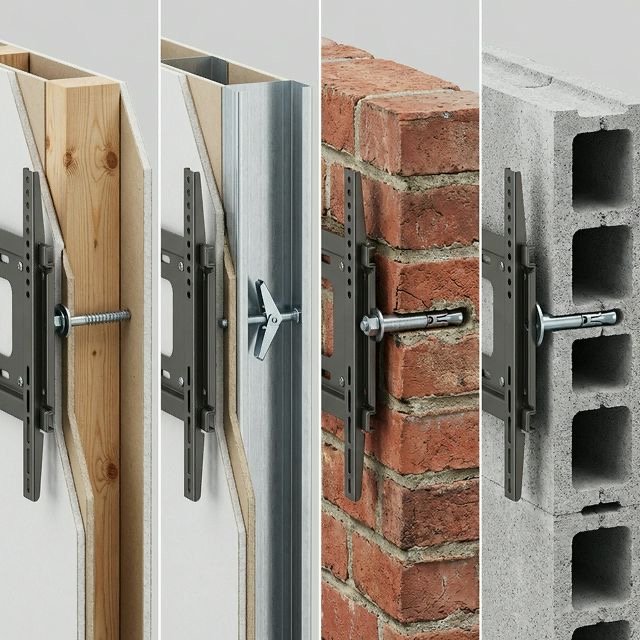
1. Plasterboard / Gyprock (Timber Studs)
Most common in: Post-1980s homes, renovations.
60% of our installs are on standard plasterboard walls with timber framing.
The Challenge
Plasterboard itself is essentially chalk wrapped in cardboard. It creates a smooth finish, but it has zero structural strength. If you screw a mount directly into plaster, it will rip out immediately.
The Solution: Find the Studs
The strength is in the vertical timber beams (studs) behind the plaster.
- Spacing: In Brisbane, studs are typically spaced 450mm or 600mm apart.
- The Hardware: 75mm x 8mm Timber Coach Screws (Lag Bolts).
- The Check: Use a magnetic stud finder to locate the nails in the stud, or an electronic finder to see density.
What if the studs aren't centered?
This is a classic problem. You want the TV centered on the wall, but the studs are 200mm to the left and right.
- Fix 1: Use a wide backplate mount (600mm+) that can span across two studs, allowing you to slide the TV left/right to center it.
- Fix 2: Install a timber backing board (plywood) across the studs, paint it to match the wall, and mount the TV to that.
2. Plasterboard (Steel Frame)
Most common in: Modern high-rise apartments, new estate builds.
Steel framing is termite-proof and straight, so builders love it. TV mounters hate it.
The Challenge
The "studs" are made of thin sheet metal (less than 1mm thick). If you use a standard timber screw, it will pierce the metal but then strip the hole as you tighten it. It provides zero "bite".
The Solution: Toggles
You cannot rely on the screw thread. You need a mechanical anchor that "flips" open inside the wall cavity to brace against the back of the steel stud.
- The Hardware: Snaptoggles (Toggle Bolts). These are rated to hold huge weights on metal studs.
- Warning: Never use a "Tek Screw" (self-drilling metal screw) for a heavy TV. They are designed for holding plasterboard sheets, not 40kg cantilevered loads.
3. Brick & Concrete Block
Most common in: Downstairs rumpus rooms, garages, older unit blocks.
This is the gold standard for strength.
The Challenge
It's hard. You can't just drive a screw in.
The Solution: Expansion
- Solid Brick: Use Dynabolts (Sleeve Anchors). As you tighten the nut, the metal sleeve expands outward, gripping the solid brick with immense force.
- Hollow/Extruded Brick: Use Ramset Universal Anchors. These knot up inside the brick cavity. Do not use Dynabolts here, as they can crack the thin brick shell.
- The Tool: You absolutely need a Hammer Drill (preferably SDS-Plus) to drill the pilot holes.
4. VJ Walls (Vertical Joint Timber)
Most common in: Queenslanders, Colonial cottages.
A Brisbane icon. These walls are made of vertical timber tongue-and-groove boards.
The Challenge
The boards are timber, which is good. But they are often thin (12mm - 19mm). While stronger than plaster, a heavy 75" TV on a full-motion arm can cause the individual boards to bow or flex outward over time.
The Solution: Spread the Load
- Strategy: Try to locate the "Stiffeners" (horizontal or vertical framework behind the VJ boards).
- If no framework found: Use a mount with a large surface area and use multiple screw points (e.g., 6 or 8 screws instead of 4) to distribute the weight across 3-4 different planks. This prevents any single board from warping.
5. Hebel (Aerated Concrete)
Most common in: Modern rendered homes, unit dividing walls.
Hebel is a lightweight, bubbly concrete product. It offers great insulation and fire protection.
The Challenge (The Danger Zone)
Hebel is soft. You can scratch it with your fingernail.
- Timber screws just spin (it turns to dust).
- Masonry expansion bolts crush the air bubbles and pull out. Hebel is the most risky surface for DIYers.
The Solution: Chemical or Specialty
- Option A (Heavy): Chemical Injection. We drill a hole, vacuum it, inject epoxy resin, and insert a threaded rod. The resin soaks into the porous Hebel and hardens into solid rock.
- Option B (Light): Ramset Hebel Anchors. Specific coarse-thread anchors designed to gently bite into the soft concrete.
6. Tiled Walls (Bathrooms / Feature Walls)
Most common in: Luxury living rooms, bathrooms.
The Challenge
Tiles are brittle. One wrong move and you crack a $100 tile (and have to pay a tiler $500 to fix it).
The Solution: Diamond & Patience
- The Tool: Diamond Hole Saw. Never use a masonry bit on hammer mode—it will shatter the tile.
- The Technique: Drill through the tile with the diamond bit (using water to keep it cool). Once you hit the substrate (brick/concrete behind the tile), switch to a standard masonry bit to drill the structural hole.
- The Spacer: If the tile is on plasterboard ("dot and dab"), you must insert a metal spacer tube so that when you tighten the bolt, you are tightening against the wall, not crushing the tile.
7. The "No-Go" Zone: Asbestos
Most common in: Pre-1990 homes (eaves, wet areas, fake brick cladding).
The Challenge
Drilling into asbestos releases deadly fibers.
Identification
If your house is pre-1990, be suspicious of any flat sheet wall ("Fibro"). Rule: If you suspect it is asbestos, WE DO NOT DRILL. It is illegal for a tradesperson to drill into asbestos without specialized abatement protocols. We will refuse the job for safety reasons.
Determining Your Wall Type: A Cheat Sheet
Not sure what you have? Tap on it.
| Sound | Feel | Likely Wall Type |
|---|---|---|
| Hollow / Echo | Smooth, cold | Plasterboard |
| Hollow / Echo | Vertical Grooves | VJ Timber |
| Solid / Dull Thud | Rough / Painted | Brick or Concrete |
| Solid / Dull Thud | Chalky / Soft | Hebel |
| Metallic Ping | Smooth | Steel Frame (behind plaster) |
Summary Advice
If you have Timber Stud Plasterboard or Solid Brick, you can likely DIY this with the right tools.
If you have Hebel, Steel Frames, Tiles, or Asbestos concerns, please call a professional. The cost of a professional install ($200-$300) is far cheaper than repairing a cracked wall or a broken TV.
MountPro Brisbane technicians carry detection equipment to identify your wall type instantly and stock anchors for every scenario listed above. Contact us today for a safe, secure installation.
Need Help Mounting Your TV?
Get a professional, safe, and clean installation from MountPro Brisbane today. 5-year warranty included.
Get a Free Quote